Home Blogs “70% of users feel stressed preparing for interviews. 90% fear freezing up. I was one of them.”
  • AI Innovators
  • People of OLX

4 min. read

AI Innovators at OLX

“70% of users feel stressed preparing for interviews. 90% fear freezing up. I was one of them.”

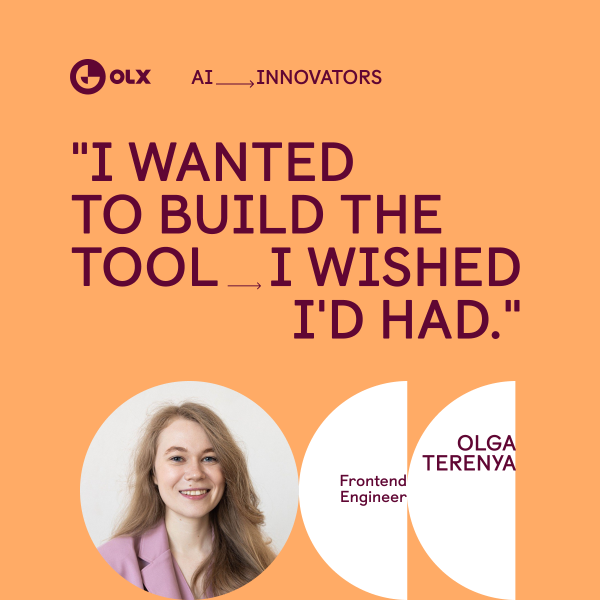
An interview with Olga Terenya, Frontend Engineer at OLX Jobs Poland — on building a Virtual Interviewer that helps job seekers practice in a space where it’s safe to fail.

Olga Terenya
Frontend Engineer

Olga, before you built the Virtual Interviewer — what was the reality for job seekers preparing for interviews?

Stressful. Genuinely stressful. Our research confirmed what most people already feel: 70% of users feel anxious preparing for interviews, and 90% fear freezing up on the day — even when they know the answers cold.

We call it the knowledge-execution gap. You can be completely prepared and still fall apart under pressure. Traditional methods — rehearsing in front of a mirror, reading generic advice online — don’t replicate the real thing. They don’t create the pressure. They don’t give you feedback you can actually use.

I know this personally. Three years ago I was job searching, and I remember exactly how nerve-wracking those first interviews felt. I had the experience. I had the knowledge. What I lacked was experience with interviews themselves — and that gap made it hard to show what I actually knew. That’s why this idea connected with me immediately. I wanted to build the tool I wished I’d had.

LinkedIn AI Olga (3)

A voice-based AI interview could easily feel intimidating or cold. What did you have to get right?

The voice was everything. We tested several options and the differences were stark — some sounded robotic enough to make the experience feel clinical and tense, which is the exact opposite of what we needed. The voice we chose was consistently praised by users for sounding natural, like talking to a real recruiter. That one decision changed the entire feeling of the product.

We also added a recruiter avatar — a visual presence to make the interaction feel less abstract. Users can turn on their own camera if they want, to simulate a real Zoom call. But video isn’t evaluated, only voice, which removes a layer of pressure. The goal was to create something realistic enough to be useful but safe enough to be honest in. That balance is hard to get right. We kept testing until we found it.


The feedback goes well beyond a score. Why was that level of detail so important to you?

Because a score alone doesn’t help anyone improve. You need to know why.

During the interview, the AI reacts in real time — asking follow-up questions if something’s missing, reassuring users that it’s okay not to have an immediate answer. That last part matters more than it sounds. Permission to pause, to think, to not be perfect — that’s what makes practice feel like practice rather than another high-stakes test.

At the end, users receive a full report: strengths and weaknesses, overall feedback, question-by-question analysis with specific tips. It’s downloadable, so they can come back to it, track their progress, compare sessions over time.

81% of users report satisfaction after successful conversations. That number tells us the detail is worth it — that people leave feeling equipped, not just evaluated.

What does success look like for you with this tool?

Real changes in real lives. That’s it.

Olek from Poland practiced twice before his next interview. He told us he went in feeling genuinely confident for the first time. That’s the story I’m building this for.

The numbers back it up: 9 in 10 users complete their sessions. 80% rate the experience positively. The average session runs nearly 7 minutes — which tells you people aren’t abandoning it halfway through. They’re engaged, working, practicing.

But the metric I care about most is the one that’s hardest to measure: does someone walk into their next interview feeling ready? We hear it in the feedback. Users tell us the Virtual Interviewer gave them a safe space to make mistakes, understand their patterns, and prepare for the real thing. That’s what we built it for.

5388956562660989098

What did OLX do — or not do — that made building this possible?

Everything started with the freedom to go deep on the problem before touching a solution. Even before December, we spent significant time on user interviews — understanding the specific fears, the exact moments where preparation breaks down, the gap between knowing something and being able to say it under pressure. OLX gave us the time and the data access to do that properly. We didn’t have to rush to a prototype before we understood the problem.

In December, we ran a design sprint — a structured week to go from insight to idea. That’s where the Virtual Interviewer was born. And then OLX gave us the ability to test prototypes with real users quickly, which meant we could learn and adjust before we’d committed to anything irreversible.

What I want to say clearly is that this was a genuine team effort. Every person on the team believed in this — understood how much it could mean to someone sitting alone, stressed, trying to prepare for something that really matters. That shared belief is what kept us moving. OLX didn’t just provide tools and process. It brought together people who cared about the same problem. That’s harder to manufacture than any technology.

The tool is live for white-collar jobs in Poland. What are you most excited to learn from real users?

We’re already seeing close to five-star ratings, and users are calling it one of the best AI job-seeking tools they’ve encountered. That’s humbling — and motivating.

What I’m most eager to learn is the thing we can’t yet measure: does it actually change what happens next? Does the person who practiced with Virtual Interviewer walk into the real interview differently? Do they get the job?

That’s the loop we’re still closing. Every piece of feedback from real candidates shapes what we build next. We’re not done. We’re just at the point where real life is finally teaching us things a prototype never could.


Olga story is part of our “AI Innovators” series. Across OLX, people are finding new ways to use AI — to create, simplify, learn, and move faster. This series celebrates the colleagues who are sharing their discoveries and inspiring others to experiment along the way.

At OLX, you don’t just work inside what the company already is. You get to help build what it becomes.

Explore open roles at OLX